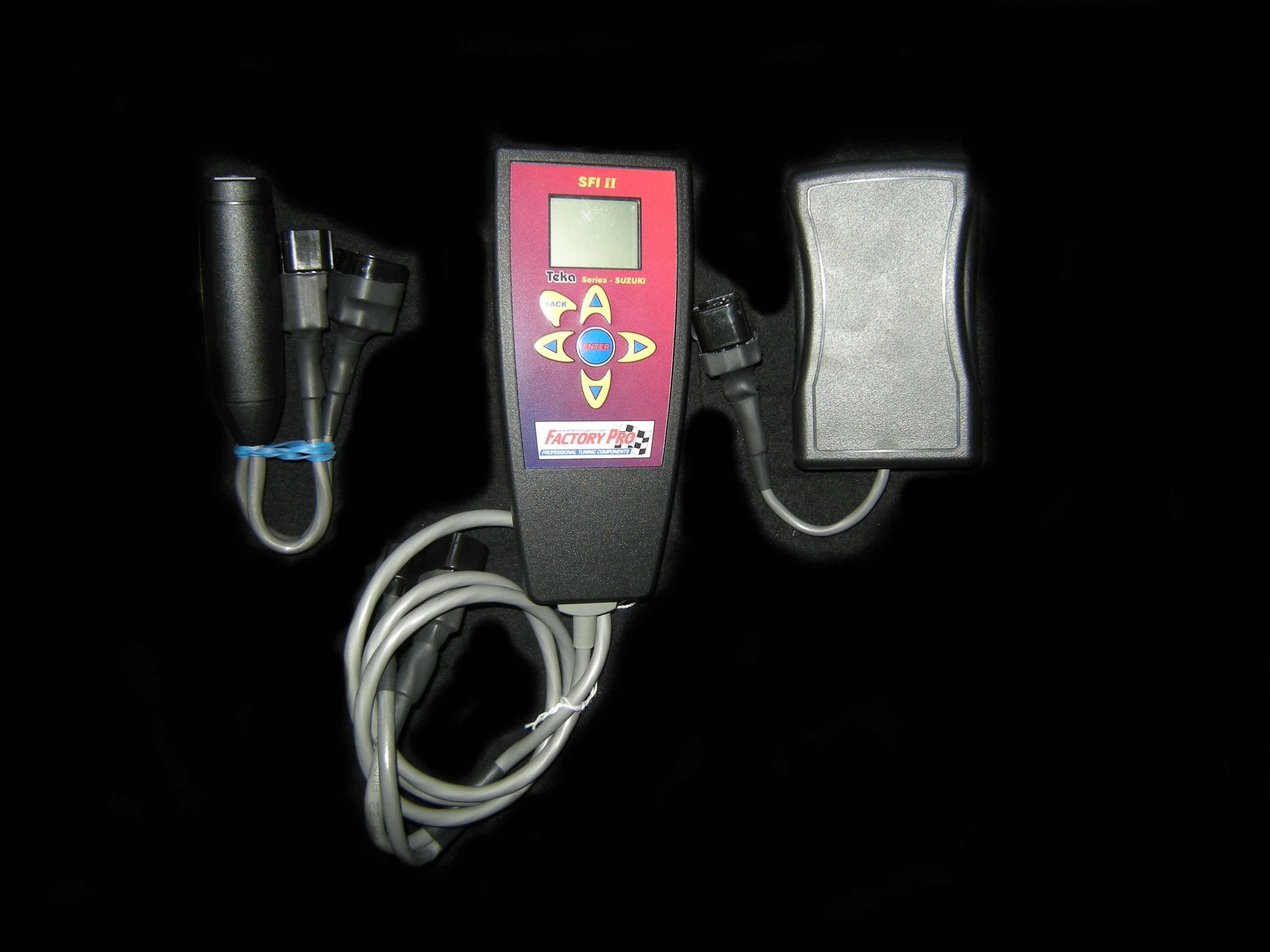
Factory Pro Power Jet Circuit tuning, GSXR750 as installed on air cooled
gsxr750 w/ 38mm Mikuni carbs, 90-92 Power jet carbs - Mikuni's great addition to a carb used
in a high rpm application. Why is the Power jet circuit difficult to tune on a simple
inertia dyno and easy on our EC997 Low Inertia dynamometer? According to the
former owner of Dynojet, the power jet circuit simply doesn't work because there
is a lag in fuel delivery at 9.5k rpm - creating a flat spot there. It turns out
that the reason that he saw that is that the dynojet dyno has insufficient load
to simulate the Real World Loading (tm) that is present on the bike in 4th and
higher gears on the road or track. There is a slight delay in the onset of Power
jet fuel delivery, but it's only vaguely present in second gear in the real
world, and not present in higher gears due to the slower acceleration rate that
occurs when you are actually riding. If you were racing, as Yoshimura USA and
other non sponsored, large US Suzuki sponsored teams (we lent them carbs for the
Finals) verified, the kit outperformed anything dynojet had to offer. How to tune: Benefits: There other applications on other motorcycles that use
circuits that are called "power jet" circuits that work on different
principles - some are electronically controlled and work in the midrange like
RGV250, the RS250 for upper topend, where they activate and deactivate through
different ranges and still others work for different reasons and by different
principles.
edited 04 20 2009 Marc Salvisberg
The power jet adjusts high rpm mixture, in the gsxr750 - from 10 to redline, in
1/3rd the step of a main jet change. Changing a main jet, in the 38mm carb, as
installed on the gsxr750, adds or subtracts up to 2% CO per main jet change -
when the CO% needs to be adjusted in in .2%-.4% for best power attainment.
Changing the power jet allowed much finer increments of change and, just as
critically, happened to change the fuel delivery curve to what was optimum for
the gsxr750 - something that would have required main air jet changes and other
modifications to attain, but would still leave the main jet fuel delivery steps
too coarse.
Strange. This Powerjet circuit works wonderfully when tuned on the stock
airboxed gsxr750 (and it's pretty straightforward to tune on our
EC997 Low Inertia Eddy Current dynamometers unlike simple inertia dynos.
The method of operation is as follows.
At full throttle, as the rpm increases, at 10k, there is enough of a
pressure differential between the float bowl and the airbox interior to draw
fuel up the black hose on the LH side of the carb and exiting through the hole
at the top of the bellmouth of the carb.
The fuel is metered by a jet that is located in the bottom of the float bowl.
The jets are sized in increments of 2.5 or .025mm. Usual size for a gsxr750 with
a stock airbox and air filter might be between #58 to #67.5.
The power jet circuit, when properly tuned, adds the equivalent of 2-3- main jet
sizes "on top" of the main jet, after 10k, so, if you were not using the power jet circuit,
i.e. had a "0" or blanked jet installed with a #125 main jet, you would use a
#117.5 with a #62.5 power jet installed.
Since this particular circuit works on the pressure difference
between the float bowl and the airbox interior, it is absolutely
affected by any change in the pressure differential. If the air filter is
changed to less restrictive unit or the airbox inlet is modified, creating less
restriction - the power jet area (size) should have to be increased above the
usual size, though, a BMC or K&N, as installed for stock replacement, may only
require 1-2 sizes increase in the power jet (in addition to +2-+3 on the main
jet circuit).
I specified "this" application, as there are other "power jet" systems that do
not rely on airbox / carb bore pressure differential. They are identified by
having a tube that is long enough to reach the center of the carb bore (where
air pressure is lowest at high velocities. In the Harley world, it's called a "Thunderjet".
If the airbox is removed on this 750, there is no longer a sufficient pressure
differential to pull the fuel up the ~2.5" vertical rise from the float bowl to
the outlet in the bellmouth and the circuit is no longer effective.
1. Install the main jet that produces the best power at full throttle /
8k-9k.
2. Install the power jet set that produces the best power at full throttle / 10k
to redline.
3. Raise or lower fuel level to get best power at full throttle / 3k.
4. Recheck main jet and needle height if you needed to lower the fuel
appreciably.
5. Adjust fuel screws for best idle.
Note - this is the "short" tuning list!
The size of the main jet DOES affect the low and midrange. Excess leanness isn't
usually the problem on these carbs. Using a #117.5 vs. a #122.5 main jet (PJ
equipped vs. using a #0 PJ ) leans and crispens the low-end and midrange for
better off idle and corner exit performance.
"Power Jet" is a catchy sounding name and it gets used every few years or so...
Why did Suzuki specify that US and UK models, for example would
have a blank or "0" jet installed, disabling the circuit and other
countries, like Canada, got the activated power jet circuit (though with pretty
odd settings)?
Emissions? I don't think so. With the basic fuel level and needle settings
virtually the same on both applications, using the larger main jet, as required
with the circuit blanked, would only increase hydrocarbon emissions under
measured conditions.
At any rate, the circuit works extremely well in dealing with
the coarse main jet metering steps of the older style gsxr750 carbs - 1st
through 5th place at the
1990 WERA Grand National Finals used our Factory Pro #CRB-S06-1.0 Carb
Recalibration Kit. Pervasive kit use followed for the next couple of years
-until 1992, the last year of the power jet.
|
|||||||||
|
LINKS |
|||||||||
![]() Train to Win |
The Rich Oliver
Mystery School will help you discover your hidden inner strength.
It will challenge you. It will teach you a new way of thinking, and a new way of riding. You can take your riding to an exciting new level! We use a variety of proven drills and training techniques. Practicing these techniques with our Yamaha dirt track trainers will enhance your abilities both on the track or the street. It doesn't matter what you ride or race, the Rich Oliver Mystery School improves everyone's skill level and mindset! |

||||||||
![]() |
Factory Pro Springr Special Book a sightseeing flight
over the Wine Country or a Kamikaze aerobatic flight or a biplane flight
over Infineon Raceway, the Golden Gate Bridge and the San Francisco
Bay for one or two during the spring and get a free souvenir t shirt! 707 938 2444 |
||||||||
![]() |
The Military Vehicle
Technology Foundation was founded by the late Jacques Littlefield. It
is located in Portola Valley, just south of San Francisco.
The
Military Vehicle
Technology Foundation oversees one of the largest and most significant
collections of historical military vehicles in the world. Our goal is
to acquire, restore, and interpret the historical significance of 20th
and 21st century military vehicles. Domestic and foreign combat vehicles
such as tanks, armored cars, self-propelled artillery, and other technically
interesting mobile platforms are the focus of the collection. We also
maintain an extensive technical library that describes many vehicles
down to the part level. Aside from the vehicles, there are towed artillery,
antitank, and antiaircraft guns. Military support equipment, inert ordnance,
and accessories round out the collection. |
||||||||
| The extension of the laboratory
for engines of the Swiss Federal Institute of Technology was completed
in about 1935. Its architect was Rudolf Otto Salvisberg (1882-1940).
He had a successful career in Berlin but returned to Switzerland after
the advent of the Nazis. His architectural style was somewhat similar
to that of Erich Mendelsohn. The staircase of the laboratory is in normal
use but well preserved. Edited to the tunes of Chemical Residue by Herbie Hancock. |
|||||||||
|
|
|||||||||